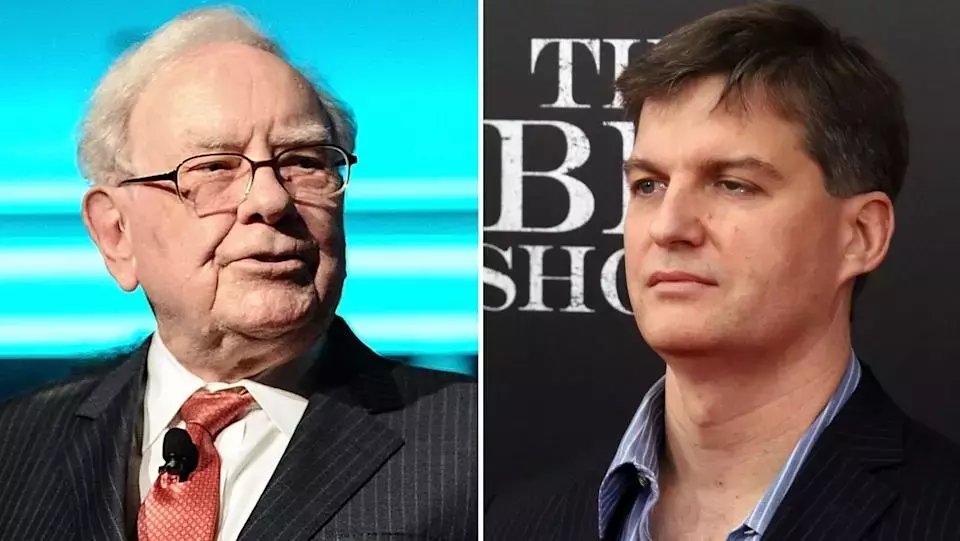
In an era where artificial intelligence stocks are driving unprecedented market rallies, two prominent investment figures, Warren Buffett and Michael Burry, stand in stark contrast to the prevailing optimism. Buffett's Berkshire Hathaway maintains an colossal cash reserve of $397 billion, reflecting a cautious stance, while Burry, famous for foreseeing the 2008 housing crisis, has executed a $1 billion short position against leading AI companies, drawing historical parallels to the dot-com bubble of 1999-2000. Their actions underscore a shared belief that the current market exuberance, particularly within the AI sector, may be unsustainable, suggesting a potential downturn lies ahead. Both advocate for a disciplined, patient investment approach, emphasizing the importance of identifying enduring value and diversifying portfolios to navigate turbulent market conditions.
The investment philosophies of Warren Buffett and Michael Burry, while distinct, converge on a cautious outlook regarding the current market environment, especially the burgeoning AI sector. Warren Buffett, the venerable chairman of Berkshire Hathaway, has long been celebrated for his value investing principles and his willingness to hold substantial cash when attractive investment opportunities are scarce. His record-breaking cash pile of $397 billion is a testament to his belief that current market valuations may not offer the margin of safety he seeks. Buffett's famous adage, 'Be fearful when others are greedy and greedy when others are fearful,' encapsulates his strategy. He views the present market as being in a 'gambling mood,' a sentiment he expressed to CNBC, indicating a widespread speculative fervor rather than sound investment.
Conversely, Michael Burry, widely recognized for his prophetic shorting of the housing market in 2008, has explicitly compared today's market to the dot-com bubble. In a recent Substack post, Burry noted the singular focus on AI, observing that 'Nobody is talking about anything else all day.' His firm, Scion Asset Management, made significant moves in 2025 by acquiring $187.6 million in put options against Nvidia and $912 million against Palantir, as reported by CNN. Both companies have seen their valuations soar due to the AI boom, with Palantir's trailing 12-month price-to-earnings ratio exceeding 150. Burry's aggressive short position underscores his conviction that these inflated valuations are unsustainable and that a market correction, particularly in the AI segment, is imminent.
Both investors have demonstrated a strategic patience, a quality they believe is crucial for long-term success. Buffett's history shows that he only finds truly 'juicy opportunities' in a handful of years, patiently waiting for market dislocations to deploy capital. His investment in Goldman Sachs during the 2008 financial crisis, which yielded a significant profit, exemplifies this approach. Burry's actions, similarly, are not about dismissing the long-term potential of AI, but rather about the timing and valuation. Many internet companies that collapsed during the dot-com bust eventually became titans, much like Amazon and Nvidia today, highlighting that the underlying technology may be valuable, but market enthusiasm can lead to premature and excessive valuations. The key, both implicitly and explicitly suggest, lies in identifying companies with durable value and acquiring them at opportune moments, not succumbing to market hype.
For individual investors, the lessons from Buffett and Burry are clear: resist the urge to chase speculative trends, prioritize long-term value, and maintain a diversified portfolio. In a market captivated by AI, their skepticism serves as a critical reminder of the importance of independent analysis and a disciplined investment strategy. Seeking guidance from financial experts or utilizing platforms that provide expert research and automated diversification can help investors navigate the complexities and potential volatility of the current market landscape, ensuring their portfolios are robust enough to weather future storms and capitalize on genuine opportunities.